


You are now leaving
this site
This link will take you to a third-party site that is not owned by US WorldMeds. Click “OK” if you would like to proceed or click “Cancel” to stay on this site.
TECELRA is for adult and pediatric patients (≥12 years of age) with advanced synovial sarcoma.† TECELRA may be right for you if you have:


Received prior
chemotherapy
Chemotherapy is a type of systemic therapy, which is a treatment that travels through the bloodstream to affect cells all over the body. You may have tried one of the following kinds of chemotherapy:
You also may have tried a non-chemotherapy systemic therapy, like pazopanib, in addition to chemotherapy.

A specific
genetic profile
This genetic profile means that your cells make a specific version of the HLA-A*02 protein. HLA proteins help your T cells respond and bind to cancer cells. In order to receive TECELRA, you need HLA-A*02:01P, HLA-A*02:02P, HLA-A*02:03P, or HLA-A*02:06P, and must not have HLA-A*02:05P.

A tumor that expresses a certain biomarker
This biomarker is called MAGE-A4, which is a protein found in some synovial sarcoma tumors. This is the protein TECELRA is designed to detect and target.

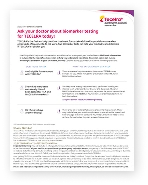
Biomarker testing will determine if you express or are positive for MAGE-A4 and HLA biomarkers
Those tests include:

A blood test
This test will check to see if you have the HLA genetic biomarker that your cells need for TECELRA to work in your body. Certain HLA proteins let your care team know if TECELRA is right for you.‡

A tumor tissue test
This test will check for a biomarker called MAGE-A4, which is the protein TECELRA-engineered T cells are designed to target. In some cases, your doctor can use tissue from a previous procedure to test for MAGE-A4.
HLA=human leukocyte antigen; MAGE=melanoma-associated antigen.
†TECELRA is for people with certain HLA-A*02 types whose tumor expresses the MAGE-A4 antigen.
‡Positive for HLA-A*02:01P, -A*02:02P, -A*02:03P, or -A*02:06P, and negative for HLA-A*02:05P.


Not an actual patient or healthcare providers.
TECELRA® is a medicine, called a genetically modified autologous T cell immunotherapy, that is used to treat synovial sarcoma. It is used when other kinds of treatment do not work. TECELRA is different from other cancer medicines because it is made from your own white blood cells that are made to recognize and attack your cancer cells. Your healthcare provider will perform tests to see if TECELRA is right for you.
Important Warning: You will likely be in a hospital before and after getting TECELRA. TECELRA may cause side effects that can be severe or life-threatening. Call your healthcare provider or get emergency help right away if you get any of the following: fever (100.4°F/38°C or higher); chills/shivering; difficulty breathing; fast or irregular heartbeat; low blood pressure; fatigue; severe nausea, vomiting, or diarrhea; severe headache; or new skin rash. Tell all your healthcare providers that you were treated with TECELRA.
TECELRA® is a medicine, called a genetically modified autologous T cell immunotherapy, that is used to treat synovial sarcoma. It is used when other kinds of treatment do not work. TECELRA is different from other cancer medicines because it is made from your own white blood cells that are made to recognize and attack your cancer cells. Your healthcare provider will perform tests to see if TECELRA is right for you.
Important Warning: You will likely be in a hospital before and after getting TECELRA. TECELRA may cause side effects that can be severe or life-threatening. Call your healthcare provider or get emergency help right away if you get any of the following: fever (100.4°F/38°C or higher); chills/shivering; difficulty breathing; fast or irregular heartbeat; low blood pressure; fatigue; severe nausea, vomiting, or diarrhea; severe headache; or new skin rash. Tell all your healthcare providers that you were treated with TECELRA.
After getting TECELRA, you will be monitored daily at the healthcare facility for at least 7 days after the infusion. You should plan to stay close to a healthcare facility for at least 2 weeks. Do not drive, operate heavy machinery, or do other activities that could be dangerous for at least 2 weeks after you get TECELRA. Your healthcare provider will do blood tests to follow your progress. It is important that you have your blood tested. If you miss a scheduled appointment for your collection of blood, call your healthcare provider as soon as possible to reschedule.
Before you receive TECELRA, tell your healthcare provider about all the medicines and supplements you take and your medical conditions, including: seizure, stroke, confusion, or memory loss; heart, liver, or kidney problems; low blood pressure; lung or breathing problems; recent or active infection; past infections that can be reactivated following treatment with TECELRA; low blood counts; pregnancy, you think you may be pregnant, or plan to become pregnant; breastfeeding; or taking a blood thinner.
The most common side effects of TECELRA include nausea, fatigue, musculoskeletal pain, infection, fever (100.4°F/38°C or higher), constipation, vomiting, headache, diarrhea, cough, fast heart rate, swelling, shortness of breath, rash, increased aspartate aminotransferase, increased alanine aminotransferase, decreased lymphocyte count, decreased white blood cell count, decreased neutrophil count, decreased red blood cell count, and decreased platelet count.
You are encouraged to report side effects to the FDA at (800) FDA‑1088 or www.fda.gov/medwatch or to US WorldMeds at 1-855-246-9232.
TECELRA® is a medicine, called a genetically modified autologous T cell immunotherapy, that is used to treat synovial sarcoma. It is used when other kinds of treatment do not work. TECELRA is different from other cancer medicines because it is made from your own white blood cells that are made to recognize and attack your cancer cells. Your healthcare provider will perform tests to see if TECELRA is right for you.
Please see Medication Guide, including Important Warning.
This link will take you to a third-party site that is not owned by US WorldMeds. Click “OK” if you would like to proceed or click “Cancel” to stay on this site.